Home/Articles/Technical Knowledge
Technical KnowledgeLaminated Tissue Napkins: What They Are, Who Buys Them, and Why the Margin Makes Sense
Laminated tissue napkins sell at ₹1.60–₹2 per piece. Standard 2-ply costs ₹0.91 to produce at the same size. Same paper, same GSM — here's what lamination adds.
Aahan Birla, Director of Exports, Product Development & Marketing, Birla Hi-Tech Machines·29 Sept 2026·6 min read

The Napkin That Feels Different
Pick up a laminated tissue napkin and the difference is immediate. It feels thicker than a standard 2-ply napkin. It has a softness — almost sponge-like — that standard tissue does not. It holds its shape when you use it. It absorbs more.
This is not a different paper. It is not a higher GSM. It is the same tissue paper, processed differently — and the result is a product that a diner, a hotel guest, or a wedding caterer's client notices before they even wipe their hands.
Laminated tissue napkins have been standard in parts of Europe for decades and at scale in China since at least 2007. In India, the product exists but remains underutilised — produced by a small number of converters, bought by a fraction of the HoReCa buyers who would benefit from it.
That gap is where the opportunity sits.
What Lamination Actually Does to Tissue
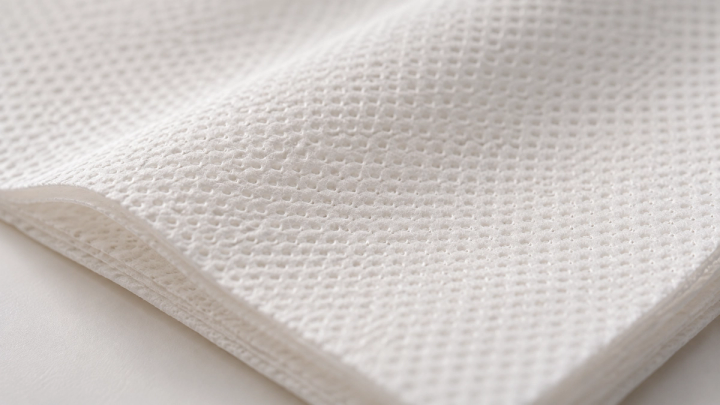
A standard 2-ply tissue napkin is produced by running two plies of tissue paper through a machine that folds and cuts them together. The plies are held together by embossing — the mechanical interlocking of the two layers through pattern pressing. This works, but it is a relatively weak bond. The two plies can separate under use, the emboss pattern on each ply may not align perfectly, and the overall structure is less cohesive than it could be.
Glue lamination changes this fundamentally. In a glue lamination process, an adhesive is applied between the two plies before they are bonded together. The result is a napkin where the plies are chemically bonded — not just mechanically interlocked. The structure is more cohesive, more consistent, and significantly more durable under use.
The embossing process used alongside glue lamination matters as well. Nested embossing — a male-to-male roller process where the embossing pattern on both plies is perfectly synchronised — ensures that the top and bottom ply patterns align precisely when bonded. The result is a more uniform surface texture, consistent pattern definition across the full napkin, and a tactile quality that feels noticeably different from standard embossed tissue.
The combined effect of glue lamination and nested embossing produces a napkin that is:
- Fluffier — the bonded structure creates more loft than mechanically interlocked plies
- More absorbent — the cohesive ply bond increases effective absorption capacity
- More durable — the napkin holds together under use without ply separation
- Better to touch — the sponge-like feel that premium hospitality buyers and their guests notice immediately
The Product Range — Where Lamination Applies
Lamination is not a product category in itself. It is a value addition that applies across multiple napkin formats and sizes. The same lamination process that produces a premium dinner napkin produces a cocktail napkin, a luncheon napkin, or any other format — the machine applies the lamination regardless of the finished size.
In the Indian market, laminated tissue napkins are most commonly produced in two primary formats:
Dinner napkins — 38×38cm and 40×40cm These are the formats used in luxury and premium restaurants, five-star hotel dining rooms, and by high-end wedding and events caterers. A 38×38cm or 40×40cm laminated napkin at a table setting communicates a quality standard that a standard 2-ply napkin cannot. For a caterer supplying premium weddings — where every detail of the table setting is evaluated by the client — the napkin is not an afterthought. It is part of the presentation.
Cocktail napkins — 22×22cm The smaller format used in bars, lounges, and cocktail service. The 22×22cm laminated napkin serves the same function as a standard cocktail napkin but with the tactile quality difference that premium bar environments demand. This format is established in European bar culture and is growing in Indian premium hospitality as the bar and mixology segment expands.
Lamination applies equally to other sizes — 33×33cm, 40×40cm, and custom dimensions. The format is determined by the market, not by the lamination process.
Who Buys Laminated Tissue Napkins
The buyer profile for laminated tissue napkins in India is concentrated in the premium segment — but it is broader than most converters assume.
Fine dining and luxury restaurants are the primary institutional buyers. A restaurant that has invested in premium crockery, linen, and service standards does not place a standard tissue napkin on its tables. The laminated napkin is a logical extension of the premium table experience.
Five-star hotels — banqueting, room service, and restaurant operations within luxury hotels all require tissue napkins that meet international hospitality standards. Laminated tissue at 38×38cm is the format that aligns with those standards.
Premium wedding and events caterers — one of the most significant and underserved segments for laminated tissue in India. High-end wedding caterers in India supply events where per-plate costs run into thousands of rupees. The napkin on the table at a premium wedding is noticed. Caterers who supply laminated tissue napkins to these events are offering a product differentiation their competitors who supply standard tissue cannot match.
Premium bars and lounges — the cocktail napkin segment, growing with India's premium bar culture.
Premium retail — laminated tissue napkins in branded packaging for the household segment, targeting consumers who want a product that feels different from standard tissue.
The Economics — And Why Standard Tissue Has Become a Commodity Trap
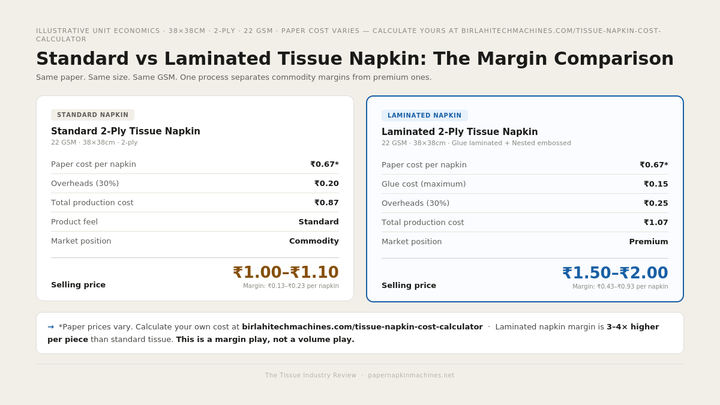
This is the argument that matters most for tissue converters evaluating whether to add lamination to their product line. I am going to use conservative numbers — maximum cost, minimum margin — so the case holds even in the worst scenario.
Standard 2-ply tissue napkin — 38×38cm, 22 GSM (example; 21–23 GSM is standard in India depending on availability):
Paper cost per napkin at current market rates: ₹0.67 (paper prices vary significantly — use the raw material cost calculator at birlahitechmachines.com/tissue-napkin-cost-calculator to calculate your own cost at current rates). Overheads at 30% (overheads vary between 20–30% depending on your operation — I am using 30% as the conservative figure): ₹0.20. Total production cost: ₹0.87 per napkin.
It sells at ₹1.00 per napkin in the market. Sometimes ₹1.10 if you have strong distribution. The margin is ₹0.13–₹0.23 per napkin — on a product that has become a commodity. Buyers negotiate every rupee. Competition on price is constant. The standard 2-ply tissue napkin is not a product anymore. It is a rate.
Laminated 2-ply tissue napkin — same size, same GSM:
Using the same calculator inputs:
Paper cost per napkin: ₹0.67. Glue cost at maximum consumption: ₹0.15 per napkin. Combined material cost: ₹0.82. Overheads at 30%: ₹0.25. Total production cost: ₹1.07 per napkin.
It sells at ₹1.50 to ₹2.00 per napkin. But here is the point that matters most: in the premium segment, you cannot put a fixed price on a napkin. A laminated tissue napkin at a luxury wedding, a five-star restaurant, or a premium bar is not priced by comparison to competitors. It is priced by the value it delivers to the buyer's table experience. The buyer is not asking "what does the cheapest napkin cost?" They are asking "what makes my table look and feel premium?"
At ₹1.50 selling price, the margin is ₹0.43 per napkin — more than three times the margin on standard tissue. At ₹2.00, it is ₹0.93 per napkin. On the same volume, the laminated converter earns significantly more. On lower volume — because premium segment buyers order less but pay more — the business is more sustainable, not less.
This is the fundamental difference between a commodity business and a differentiated one. In commodity tissue, you compete on price and hope your costs stay lower than your competitors. In premium laminated tissue, you compete on product quality and the buyer's experience — and price becomes a signal of that quality, not a constraint on your margin.
The differentiation argument:
Standard tissue converters across India are competing for the same buyers, at the same price points, with the same product. Every year, margins compress a little more. Every year, the buyer has more options and more leverage. The converter who adds lamination is not fighting in that market anymore. They are in a different market entirely — one where the product is chosen, not priced.
A tissue converter who can walk into a luxury caterer and say "this napkin feels different, absorbs more, holds together better, and costs ₹1.60 per piece" is not competing with the converter selling standard tissue at ₹1.00. They are selling a different product to a different buyer at a different margin. That is what product differentiation actually means in the tissue industry.
What Laminated Tissue Needs to Become Mainstream in India
The product exists. The buyers exist. The margin exists. What is missing is converting capacity at scale.
Laminated tissue napkin production requires a dedicated lamination machine — a glue lamination and embossing unit that processes tissue paper post-production, applying adhesive and embossing simultaneously. This is not a modification of a standard napkin machine. It is a separate, specialised piece of equipment.
India's first glue lamination and nested embossing machine — the Fusionex, built by Birla Hi-Tech Machines — represents the first domestically manufactured option for converters who want to add this capability without importing equipment. Full specifications are available at birlahitechmachines.com.
For tissue converters evaluating a move into the premium segment, laminated tissue napkins are the clearest available path from commodity production to margin-led business.
To calculate your own raw material cost per napkin at current paper prices, use the Birla Hi-Tech Machines tissue napkin cost calculator: birlahitechmachines.com/tissue-napkin-cost-calculator The product is proven globally. The Indian market is underpenetrated. The economics are straightforward.
The question is not whether the opportunity exists. It is whether your converting operation is equipped to serve it.
Aahan Birla is Director of Exports, Product Development & Marketing at Birla Hi-Tech Machines — a third-generation tissue paper conversion machine manufacturer based in Faridabad, Haryana, with machines running across 22 countries.
The Tissue Industry Review is an independent editorial publication covering the tissue conversion and paper products manufacturing sector in India and globally.
/ RELATED ARTICLES
Keep Reading

Technical Knowledge
B-Fold Napkins: The Smarter Alternative to Standard Tissue Napkins
B-fold napkins are cheaper per unit than standard 1-ply tissue, more absorbent, and more hygienic. Here's the math — and why the Indian market hasn't caught up yet.
25 Sept 2026· 6 min read

Technical Knowledge
Bamboo Tissue: A Sustainable Alternative and Why Responsible Raw Material Sourcing Matters for Tissue Converters
The real opportunity in sustainable tissue isn't bamboo alone — it's ensuring every fibre, whether bamboo or virgin wood pulp, is sourced responsibly. A perspective from Orient Paper.
21 Jul 2026· 5 min read

Technical Knowledge
What Raw Materials Does a Paper Napkin Machine Need?
The machine gets all the attention. The raw material decision is equally important and gets almost none. Here's what goes into a paper napkin machine — and what to get right before production starts.
18 Jul 2026· 6 min read