Home/Articles/Technical Knowledge
Technical KnowledgeB-Fold Napkins: The Smarter Alternative to Standard Tissue Napkins
B-fold napkins are cheaper per unit than standard 1-ply tissue, more absorbent, and more hygienic. Here's the math — and why the Indian market hasn't caught up yet.
The Tissue Industry Review·25 Sept 2026·6 min read

A Format Most of India Hasn't Discovered Yet
Walk into a Starbucks anywhere in the world and you will find a small, compact napkin sitting in a tabletop dispenser near the counter. You pull one out by a small flap at the top — one napkin, clean hands, no mess, no waste. That is a B-fold napkin.
Known by different names across different markets — B-fold in most of Asia and export markets, master fold in parts of the US, low fold in some European markets — this napkin format has been standard in high-traffic quick service environments globally for decades. In India, it remains largely unknown outside multinational chains.
That gap is an opportunity. For tissue converters, for HoReCa buyers, and for anyone currently buying standard 1-ply paper napkins who has not yet run the cost comparison.
What a B-Fold Napkin Actually Is
A B-fold napkin is a two-fold napkin designed specifically for use in tabletop dispensers. The open size is 33×22cm — slightly narrower than a standard 30×30cm napkin but taller. It is folded twice to a finished size of approximately 6.5"×5", which is the industry standard dimension for tabletop dispenser compatibility worldwide.
The defining feature of the B-fold is its flap. When folded, the top layer of the napkin extends slightly beyond the fold — creating a small tab that the user pinches to pull the napkin out of the dispenser. This flap is not decorative. It is functional, and it solves a problem that every person who has eaten at a restaurant has experienced.
The 33×30.5cm open size is also available for buyers who need a slightly larger napkin — but the 33×22cm is the global standard for tabletop dispenser applications and the format with the broadest market fit.
The Hygiene Argument — Why the Flap Matters
Standard napkin dispensers — the kind holding a stack of 1/4 fold napkins on a restaurant table — have a hygiene problem that nobody talks about directly.
When a diner's hands are oily, greasy, or covered in food, reaching into a napkin dispenser means one of two things: they pull out more napkins than they need because the stack doesn't separate cleanly, or the oil and food residue on their fingers transfers to the napkins left behind in the dispenser — contaminating the entire stack for the next person.
The B-fold dispenser eliminates both problems. The napkin is dispensed one at a time through a slot in the dispenser. The user pinches the flap — the one clean part of the napkin that extends above the slot — and pulls. One napkin comes out. Their fingers never touch the remaining stack. The next person reaches into a clean dispenser.
In a high-traffic environment — a QSR counter serving 200 covers a day, a pizza shop, a cafe, a traditional diner — this is not a minor operational detail. It is a meaningful food hygiene improvement that requires no change in behaviour from the customer, only a change in the napkin format and dispenser.
Tork, one of the world's leading hygiene product companies, has supplied B-fold dispensers for decades. Starbucks globally — including in India — uses this format at its counters. The hygiene case is established. The Indian market simply hasn't acted on it yet at scale.
The Cost Comparison — Where the Argument Gets Interesting
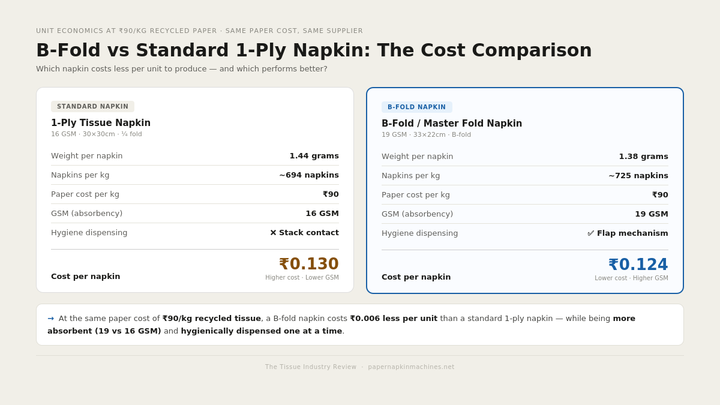
The assumption most tissue buyers make about B-fold napkins is that they cost more than standard tissue. This assumption is wrong — and the math is straightforward enough to verify before the end of this article.
The calculation basis:
- Paper cost: recycled tissue at ₹90 per kg (current market rate)
- Both options compared at the same paper cost per kg
B-Fold Napkin — 19 GSM, 33×22cm
Weight per napkin = (33 × 22 × 19) ÷ 10,000 = 1.38 grams Napkins per kg = 1,000 ÷ 1.38 = ~725 napkins per kg
Wait — let me recalculate correctly:
Weight per napkin (in grams) = Length(cm) × Width(cm) × GSM ÷ 10,000 = 33 × 22 × 19 ÷ 10,000 = 13,794 ÷ 10,000 = 1.38 grams per napkin
Napkins per kg = 1,000 ÷ 1.38 = ~725 napkins Paper cost per napkin = ₹90 ÷ 725 = ₹0.124 per napkin
Standard 1-Ply Napkin — 16 GSM, 30×30cm
Weight per napkin = 30 × 30 × 16 ÷ 10,000 = 1.44 grams per napkin Napkins per kg = 1,000 ÷ 1.44 = ~694 napkins Paper cost per napkin = ₹90 ÷ 694 = ₹0.130 per napkin
The result:
A B-fold napkin at 19 GSM costs ₹0.124 per napkin in paper. A standard 1-ply napkin at 16 GSM costs ₹0.130 per napkin in paper.
The B-fold napkin — at a higher GSM, larger open size, and better hygiene performance — costs less per unit in raw material than the standard tissue napkin it replaces.
And it is more absorbent. 19 GSM versus 16 GSM means more fibre per square centimetre. A B-fold napkin absorbs more than a standard 1-ply napkin — while costing less to produce.
For a tissue converter evaluating a new product line, or a HoReCa buyer comparing procurement costs, this is the number that changes the conversation.
Where B-Fold Napkins Work Best
The B-fold format is not a universal replacement for all napkin applications. It is the right format for specific environments — and in those environments, it outperforms standard tissue on every measurable dimension.
High-traffic QSR counters — burger chains, pizza shops, sandwich bars, coffee shops. Customers are moving quickly, hands are often messy, and dispenser hygiene matters. The B-fold's one-at-a-time dispensing reduces waste and contamination simultaneously.
Cafe and coffee shop countertops — the format Starbucks built its counter napkin standard around. Compact dispenser footprint, clean dispensing, premium feel relative to a napkin stack.
Traditional diners and mid-tier restaurants — where tabletop dispensers are already in use. Switching from standard 1/4 fold napkins to B-fold requires only a dispenser change, not a behaviour change.
HoReCa institutional supply — hotels, catering operations, and corporate cafeterias where hygiene standards are formally evaluated. The B-fold's documented hygiene advantage is a procurement argument, not just a preference.
For the premium segment — fine dining, luxury hospitality — a 2-ply B-fold at higher GSM offers the same dispensing hygiene with a noticeably more premium hand feel. The format scales up the quality ladder as well as it works at the mid-tier.
The Market Opportunity for Indian Converters
India's QSR sector is one of the fastest-growing food service segments in the country. Chains like Starbucks, McDonald's, Domino's, and hundreds of domestic QSR brands are expanding rapidly into tier 2 and tier 3 cities. Every new outlet needs napkins. Most of them are currently sourcing standard 1/4 fold tissue.
The converter who approaches these buyers with a B-fold alternative — cheaper per unit, more hygienic, dispenser-compatible, globally standard — is not selling them an upgrade. They are selling them the same product their international parent company already uses, at a lower cost than what they are currently buying.
That is a straightforward procurement conversation.
The dispenser is the only additional consideration. Tabletop B-fold dispensers are widely available in India — Tork and several domestic alternatives supply them. For a HoReCa buyer already spending on napkin procurement, the dispenser is a one-time capital cost against ongoing savings on napkin unit economics.
For Tissue Converters: What You Need to Produce B-Fold
Producing B-fold napkins requires a machine specifically configured for this fold type — not a standard 1/4 fold napkin machine. The fold geometry, the web path, and the output stacking are different.
India's first B-fold machine is manufactured by Birla Hi-Tech Machines — the BHM-BF-01, representing the 13th India First in the family's manufacturing history spanning 1977 to 2026. Full machine specifications are available at birlahitechmachines.com.
The Tissue Industry Review is an independent editorial publication covering the tissue conversion and paper products manufacturing sector in India and globally.
/ RELATED ARTICLES
Keep Reading

Technical Knowledge
Laminated Tissue Napkins: What They Are, Who Buys Them, and Why the Margin Makes Sense
Laminated tissue napkins sell at ₹1.60–₹2 per piece. Standard 2-ply costs ₹0.91 to produce at the same size. Same paper, same GSM — here's what lamination adds.
29 Sept 2026· 6 min read

Technical Knowledge
Bamboo Tissue: A Sustainable Alternative and Why Responsible Raw Material Sourcing Matters for Tissue Converters
The real opportunity in sustainable tissue isn't bamboo alone — it's ensuring every fibre, whether bamboo or virgin wood pulp, is sourced responsibly. A perspective from Orient Paper.
21 Jul 2026· 5 min read

Technical Knowledge
What Raw Materials Does a Paper Napkin Machine Need?
The machine gets all the attention. The raw material decision is equally important and gets almost none. Here's what goes into a paper napkin machine — and what to get right before production starts.
18 Jul 2026· 6 min read