Home/Articles/Export & Markets
Export & MarketsNigeria Tissue Paper Market: A Guide for Tissue Machine Buyers and New Manufacturers
Nigeria is Africa's largest tissue paper market - 43% of continental consumption, growing at 5.8% annually, with domestic production meeting just 7% of demand. The manufacturing gap is enormous.
The Tissue Industry Review·18 Jul 2026·6 min read

Africa's Largest Tissue Market — And Its Biggest Manufacturing Gap
Nigeria is the largest tissue paper consuming country in Africa. In 2024, the country accounted for 43% of the continent's total tissue consumption — approximately 2.5 million tonnes. The market is valued at USD 181 million and is projected to grow at a CAGR of 5.8% through the forecast period, driven by a population of over 225 million, rapid urbanisation, and increasing hygiene awareness post-COVID.
The manufacturing reality behind these numbers is striking. Domestic mills currently meet approximately 7% of Nigeria's total paper demand. The remaining 93% is either imported or unmet. For tissue manufacturers and entrepreneurs looking to enter the Nigerian market, this gap represents one of the most significant manufacturing opportunities on the continent.
Nigeria's government recognised this opportunity early. In 2004, tissue paper products were placed on the list of items restricted from importation — a deliberate policy measure to encourage local production and reduce dependence on imports. Two decades later, the gap between local production capacity and domestic demand remains substantial. The entrepreneurs who move to close it with the right equipment are positioned to serve a market that is structurally underserved and growing.
What the Nigerian Tissue Market Actually Looks Like
Nigeria's tissue paper import market grew at a CAGR of 50.1% from 2020 to 2024 — one of the fastest growth rates recorded for any tissue market globally over that period. The top exporting countries supplying tissue to Nigeria are China, India, the USA, Hong Kong, and the UAE. India is already an established supplier in this market, which means Indian-origin tissue products — and Indian-made machines producing them — are not unfamiliar to Nigerian buyers and distributors.
The product categories in highest demand mirror what is consumed across most developing markets: toilet rolls, facial tissues, and paper napkins for both household and institutional use. The institutional and hospitality segment — hotels, restaurants, offices, and catering — represents a significant and growing share of demand in Lagos, Abuja, Port Harcourt, and other urban centres.
Bel Papyrus, based in Nigeria, is the largest tissue reel manufacturer in West Africa and supplies parent reels to converting operations across the region. The presence of a major local reel supplier reduces one of the key raw material sourcing challenges for new converting operations — tissue paper reels can be sourced domestically rather than imported, which significantly improves production economics.
The Manufacturing Opportunity for New Entrants
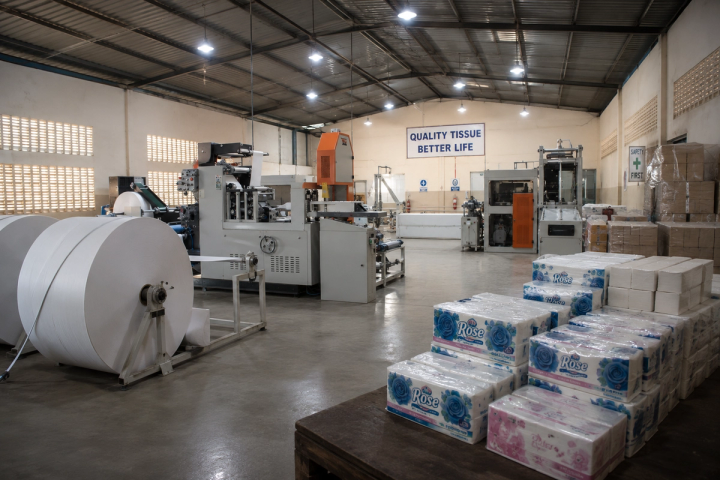
For an entrepreneur entering the Nigerian tissue market, the business case is straightforward: large and growing demand, limited local production, government policy that favours local manufacturing, and a domestic raw material supplier in Bel Papyrus.
The right entry point for most new manufacturers is a paper napkin machine or a toilet roll rewinder — the two product categories with the broadest consumer demand and the most established distribution infrastructure in Nigeria.
A paper napkin machine producing standard 1/4 fold 30×30cm napkins addresses the restaurant, hotel, and household segment simultaneously. A toilet roll rewinder addresses the household and institutional segment. Both can be operated with a small team, modest factory space, and locally sourced parent reels.
For full specifications on napkin machines suited to new market entrants, visit click here. For toilet roll rewinders suited to the Nigerian market, click here.
The key challenge Nigerian manufacturers consistently cite is reliable equipment. Inconsistent machine quality — and the downtime that follows — is documented as one of the primary constraints on local tissue production growth. A manufacturer who enters with reliable equipment is not just better positioned than their local competitors. They are better positioned than the imported tissue products they are competing against on price and availability.
Why Indian Machines Make Sense for Nigeria
Nigeria's tissue machine market has been dominated by Chinese-origin equipment, largely on the basis of price. Indian machines from established manufacturers occupy a different position: built to a higher engineering standard than budget Chinese machines, at a fraction of the cost of European equipment.
For a Nigerian manufacturer evaluating machines, this matters in three specific ways:
After-sales support. A machine that breaks down in Lagos needs an engineer who can respond — not a parts shipment from overseas on a six-week timeline. Indian manufacturers with genuine export infrastructure provide on-site commissioning, phone and WhatsApp support, and spare parts supply from India with significantly faster shipping times than Chinese or European alternatives.
Component quality. The difference between a machine that runs for 15 years and one that requires constant repair is largely determined by the quality of bearings, automation systems, and pneumatic components specified at the time of manufacture. Established Indian manufacturers — those using Japanese bearings, Siemens automation, and European pneumatic components — build machines that hold their performance over time. This is a verifiable specification, not a marketing claim.
Price point. Indian machines sit between budget Chinese equipment and European machines on price, while matching or exceeding European component standards in the best cases. For a Nigerian manufacturer entering a market with thin initial margins, this combination of upfront affordability and long-term reliability changes the capital investment calculation significantly.
For a detailed comparison of what separates quality-tier tissue machines from budget alternatives, read What's Actually Inside Your Tissue Machine on The Tissue Industry Review.
What to Verify Before Importing a Machine
Importing a tissue machine is a capital decision that will follow your business for 15 to 20 years. Before you commit to any supplier, verify the following:
Component specification. Ask which bearing brands are installed — FYH, Nachi, NSK, or unspecified. Ask what automation system the machine runs and whether it can be serviced locally. Ask about pneumatic component brands. A manufacturer who cannot answer these questions specifically is using components they would rather you not research.
Warranty period and coverage. The minimum warranty in India is 12 months. The longest available from any Indian manufacturer is 18 months, covering all mechanical and electrical components. Confirm what is covered and what is excluded before you sign.
Commissioning support. Confirm that the manufacturer's own engineer will commission the machine at your facility — not a third-party agent, not a manual. On-site commissioning and operator training is the standard that serious manufacturers deliver.
References in Africa. Ask for the names of clients in Nigeria or neighbouring African markets who have been running the manufacturer's machines for three or more years. A manufacturer with genuine African traction can provide these. One without it cannot.
For the full buyer's verification framework, read How to Find the Best Paper Napkin Machine Manufacturer in India on birlahitechmachines.com.
Birla Hi-Tech Machines in Nigeria
Birla Hi-Tech Machines has supplied tissue conversion machines — napkin machines and toilet roll rewinders — to manufacturers in Nigeria. The company has delivered over 1,200 machines across 22 countries, with a family manufacturing legacy tracing to 1977 and 25 years of export experience.
Their machines specify FYH and Nachi Japanese bearings, Siemens PLC and HMI automation, and European pneumatic components. The 18-month warranty — the longest offered by any Indian tissue machine manufacturer — covers all mechanical and electrical components. Every machine is commissioned on-site by Birla's own engineers.
For Nigerian manufacturers and entrepreneurs evaluating tissue machine options, Birla Hi-Tech Machines is available for direct consultation on machine specifications, production requirements, and export documentation.
📞 Call / WhatsApp: +91 92055 79798 📞 International enquiries: +91 98110 19798 ✉️ info@papernapkinmachines.com 🌐 birlahitechmachines.com 🌐 papernapkinmachines.com — 6 Color Flexographic Printing Napkin Machine
The Tissue Industry Review is an independent editorial publication covering the tissue conversion and paper products manufacturing sector in India and globally. Market data sourced from IndexBox, Cognitive Market Research, and Statista.
/ RELATED ARTICLES
Keep Reading

Export & Markets
Oman Tissue Paper Market: A Guide for Tissue Machine Buyers and Manufacturers
Oman pays USD 1,624 per tonne for imported tissue — among the highest in the Middle East. That's not a price-sensitive market. Here's what machine buyers need to know.
23 Jul 2026· 6 min read

Export & Markets
UAE and Dubai Tissue Paper Market: A Guide for Tissue Machine Buyers and Manufacturers
The UAE has the highest per capita tissue consumption in the Middle East, a booming hospitality sector, and re-export reach to the US and UK. Here's what machine buyers need to know.
22 Jul 2026· 6 min read