Industry News
Duni Group Enters India: What It Means for the Premium Napkin Market
Duni Group — 70 years of European tabletop heritage — has formally entered India. Here's what it signals for the Indian premium napkin market.
The Tissue Industry Review·19 Jul 2026·5 min read
A European Premium Brand Bets on India
Duni Group, the Swedish tabletop solutions company with over 70 years of heritage and presence across 25+ countries, has formally entered the Indian market through India House Project — a Mumbai-based brand entry firm backed by Samta Group — making Duni its flagship brand for the Indian market.
India House Project describes its first chapter as beginning with Duni, calling it "the leading European brand committed to premium, sustainable tabletop solutions" and positioning the entry as "forged through a deep partnership with Samta Group, rooted in transparency, professional leadership, and a shared belief in long-term value creation."
This is not a distributor arrangement or an e-commerce listing. It is a structured, formal market entry through a dedicated brand management entity — India House Project Hospitality Solutions Pvt Ltd, registered in Fort Mumbai — with the specific mandate of building Duni's brand presence across India's hospitality and foodservice sectors.
Duni does not enter markets speculatively. A company of this scale and heritage makes market entry decisions based on rigorous analysis of consumer readiness, distribution infrastructure, and long-term growth potential. Their decision to enter India now — and to do so through a dedicated market entry partnership rather than a simple import arrangement — is itself a statement about where the Indian premium dining segment stands in 2026.
What Duni Brings to the Indian Market
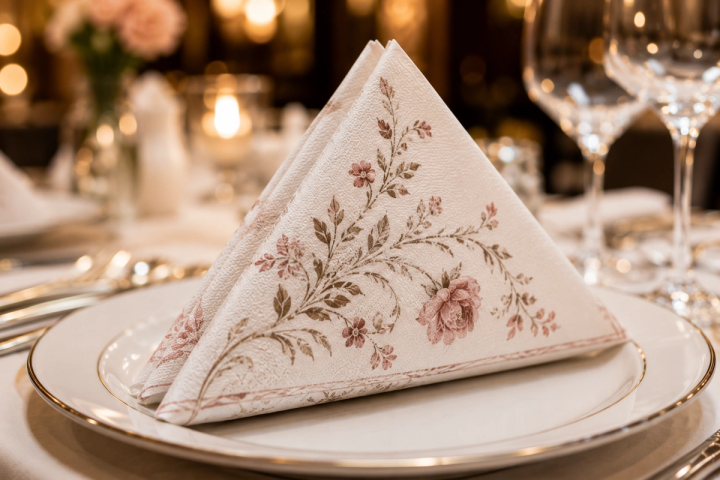
Duni Group markets and sells its products under the brands Duni, BioPak, Paper+Design and Poppies, which are represented in more than 50 markets. The Indian entry focuses on the Duni brand — premium napkins, tabletop concepts, and sustainable dining solutions for the HoReCa sector.
Duni's tissue napkins are available in unicolours and designs, in sizes ranging from 24×24 to 40×40cm, in formats including 1/8 bookfold, and are made from virgin fibres sourced from responsibly managed forests. Their Bio Dunisoft range — napkins made using an innovative binder derived from corn, lemon peels, and other food waste — represents the premium end of their sustainable product portfolio.
The target market in India is clear: fine dining restaurants, luxury hotels, airlines, corporate catering, and premium events — segments where the napkin on the table is a deliberate brand statement rather than a commodity input. This is not the market for plain white tissue napkins at ₹1 per packet. This is the market where the product sitting on a guest's table is expected to communicate quality before a single dish arrives.
What This Signals for the Indian Tissue Market
Duni's entry into India is significant beyond the brand itself. It is a data point about the Indian premium dining segment that the tissue and napkin manufacturing industry should read carefully.
India's tissue paper market is valued at USD 7 billion in 2024 and projected to reach USD 10.5 billion by 2033, growing at approximately 8–9% annually. Within that market, the premium and designer segment — printed napkins, sustainable tabletop solutions, hospitality-grade tissue — has been the fastest-growing category, driven by the expansion of organised food service, the growth of fine dining and QSR chains, and post-COVID elevation of hygiene standards across institutional buyers.
When a brand like Duni, with the market intelligence and institutional rigour of a 70-year-old European company, commits to a formal India entry, it validates what Indian market observers have been noting for several years: the premium segment is no longer a niche. It is becoming a mainstream category with sufficient scale to justify serious investment.
For Indian tissue manufacturers who have been producing commodity napkins for price-sensitive markets, Duni's arrival sets a new quality benchmark in their own backyard. The hospitality buyers, hotel chains, and restaurant groups that Duni is targeting in India are the same buyers that progressive Indian manufacturers have been trying to move upmarket to serve. Those buyers now have a premium European option available to them domestically — and the Indian manufacturers who cannot match that quality standard will find the premium segment closing to them.
What This Means for Machine Buyers and Manufacturers
The implications for tissue converting machine buyers are direct.
Producing napkins that can compete in the segment Duni is targeting — or that can serve the distributors and hospitality buyers Duni will build relationships with — requires a different machine specification than producing commodity white napkins for the wholesale market. Designer and printed napkins require flexographic printing capability. Premium fold quality requires precise engineering tolerances. Consistent output across large hospitality orders requires machines that do not drift in performance over time.
The Indian manufacturers who are already equipped to produce at this standard are well-positioned as Duni's entry grows the premium segment. Those who are not will need to make equipment decisions now — before the segment hardens around a quality standard they cannot meet.
Duni's India entry is not a threat to Indian tissue manufacturers. It is a signal that the market they have been trying to move upmarket into is larger and more ready than most of them have acted on. The manufacturers who read it that way, and invest accordingly, will be the ones serving India's premium dining sector five years from now.
A Market in Transition
India House Project's stated mission is to help "premium global brands unlock India's vast consumer opportunity" — with Duni as its flagship collaboration and more global lifestyle brands planned to follow.
Duni is the first. More will come. The Indian premium tabletop and dining solutions market is entering a phase of formalisation — global brands arriving with structured distribution, sustainability credentials, and design standards that domestic markets have not previously seen at scale.
For the Indian tissue converting industry, this transition is both a challenge and an opportunity. The challenge is clear: a 70-year European brand with global supply chain, sustainability certifications, and premium positioning is now competing in your market. The opportunity is equally clear: the segment that brand is validating by entering is the one your business should be building toward.
The manufacturers who treat Duni's arrival as a wake-up call — and invest in the machines, the raw materials, and the product quality to compete in the premium segment — will find themselves in a market that is growing, profitable, and increasingly difficult for commodity producers to enter.
The Tissue Industry Review is an independent editorial publication covering the tissue conversion and paper products manufacturing sector in India and globally. Sources: India House Project (indiahouseproject.com), Duni Group (dunigroup.com).
